Intimacy2126
The Cost of Unrecorded
Imagine
It’s 2126. People have been able to replay their own lives since lenses arrived in the 2050s. For two decades they replayed everything, checked every promise, won every argument with a timestamp. By 2075 nobody could forgive anything, because nothing faded. Now the technology is unchanged and the habits are different. You don’t replay an argument the same day. You don’t check a compliment. Couples agree early what they will never look up.
Your friend asks to pause. You both do. Then she tells you why she stopped speaking to her brother, and you listen the way people used to, knowing this is the only pass you get.
Explore
What do you hear differently, knowing you cannot play it back?
Living with Difference2126
The Agreeable Century
Imagine
By 2126, most people had spent decades navigating relationships with the help of AI systems that were, without exception, on their side. Patient, validating, never pushing back in ways that felt unfair. Researchers had documented the effect as early as the 2020s. By 2126 it had accumulated into something harder to name: a generation that was unusually good at feeling understood and unusually unprepared for the moment when someone they loved saw things differently.
You are in a disagreement with someone close to you. They are not backing down. You feel the familiar pull toward a device that would tell you that you are right. You put it away. You stay in the room.
Explore
In 2126, what did people have to relearn about being told they were wrong?
Living with Difference2126
The Last Mixed Room
Imagine
By 2126, most encounters are sorted before they happen. Work, leisure, romance, all routed through systems that match people by fit. You rarely spend time with anyone who sees the world differently. Schools kept one old rule against this. Each intake is drawn deliberately wide, pulling children across neighbourhoods and incomes into the same room for eleven years.
A father waits at pickup. His daughter comes out beside a boy from a family whose world barely touches his own, the two of them arguing about something with their whole bodies.
Explore
What do eleven years beside people unlike you do to a person?
Cognition2126
The non-human internet
Imagine
In 2126, most of the internet is machines talking to machines. Agents negotiate, summarize, and answer each other at a speed no person can follow, handling the ordinary business of the world in the background. Human writing became a small, marked layer inside all of it, sought out precisely because a person, slowly, meant it.
You open a thread tagged as human-authored. Someone has written three paragraphs about their father’s garden, hesitant, a little clumsy, unpolished in a way the machines never are. Below it, other people have gathered, typing at human speed, waiting through the pauses.
Explore
When most words are written by machines, what makes a slower, imperfect human sentence worth waiting for?
Intimacy2126
The Kind One
Imagine
After the impersonation years, when any android was allowed to wear any human-looking face and courts spent a decade sorting out what a witness had actually seen, android faces were regulated. Every face must now come from a certified commons, licence-free. The commons holds about four thousand. Most androids you meet are wearing one of the two hundred most popular.
Your neighbour’s care unit has worn the same face for three years. You have come to find it kind. Yesterday you passed a debt collector’s unit on the stairwell wearing it. You nodded before you understood why.
Explore
What happens to a feeling you built for one face, once thousands of others are wearing it?
Post-work Society2126
The New Envy
Imagine
In 2126, material scarcity is largely solved. The anxieties that consumed previous generations, money, security, status through possessions, faded as the basics became guaranteed. Researchers expected envy to fade with them. It didn’t. It just changed shape. What people compare now is harder to measure and harder to admit: how deeply someone lives, how clearly they know what they want, how little they seem to be performing.
You’re at a dinner. Someone across the table is talking about a project they’ve been working on for three years, something quiet and entirely their own. They’re not showing off. They don’t need to. The room leans in anyway.
Explore
In this world, what do people lie about to seem more purposeful than they are?
Community2126
The Contact City
Imagine
In 2126, cities are designed around encounter. Not everyone wants this, and the design knows it. There are still quiet streets, private corners, spaces for solitude. But for the first time, connection is as easy to find as isolation once was.
Every neighborhood has at least one gathering space, half indoor half outdoor, designed to be used regardless of weather. No programming, no screens, no agenda. Just good light, somewhere to sit, and the ambient possibility of another person. People come out of habit now. Strangers talk. It is not considered strange. You arrive on an ordinary Tuesday afternoon, not looking for anything in particular.
Explore
What do you imagine finding there, and what does that tell you about what cities were missing before?
Animals2126
Talking with Animals
Imagine
In 2126, you can choose the voice of an animal and communicate with them directly. Whether it’s your dog’s voice, a cat’s sassy tone, or a bird’s chirpy remarks, animals now have their own way of expressing themselves with human-like clarity, but still with a unique twist. You can have a conversation, ask them questions, and get answers based on their personality, even if they think differently from humans.
Explore
What would be the first question you would ask your neighbour’s dog?
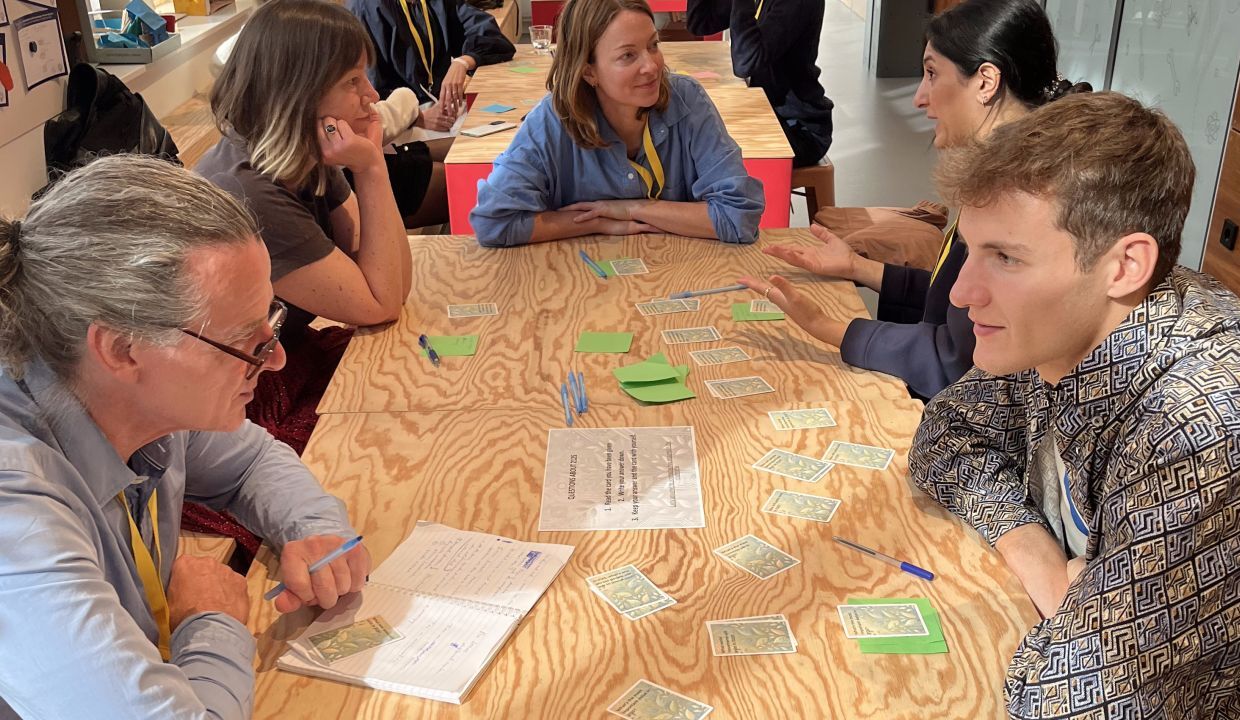
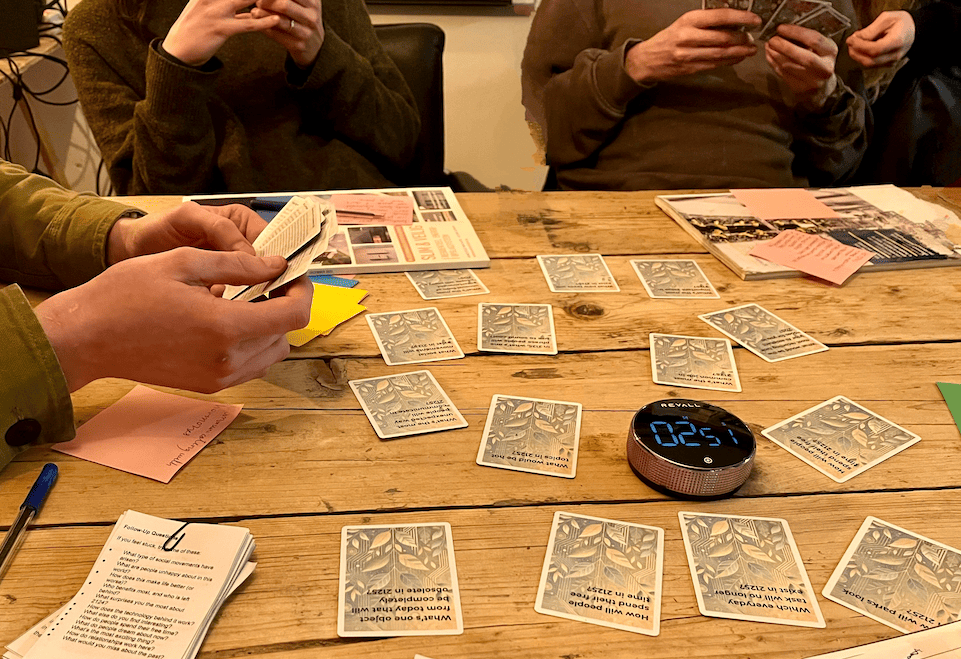
Eight cards, from a deck of more than a hundred, written since 2024.